Our adventure of discovering different faces of libraries in Prague happened on 13 November. We visited 4 different branches of the Library with different histories, purposes and general atmospheres. We planned to visit the fifth one, but due to time constraints we couldn’t make it. We skipped branch called Kiosek at one of the shopping malls, which is mostly specific thanks to this untraditional placing. I visited it other day and it is a great initiative to make libraries and books spacially accessible.
Question 1: During the excursion we visited several types of libraries. What were the main differences you observed between them (library processes, space, etc.)?
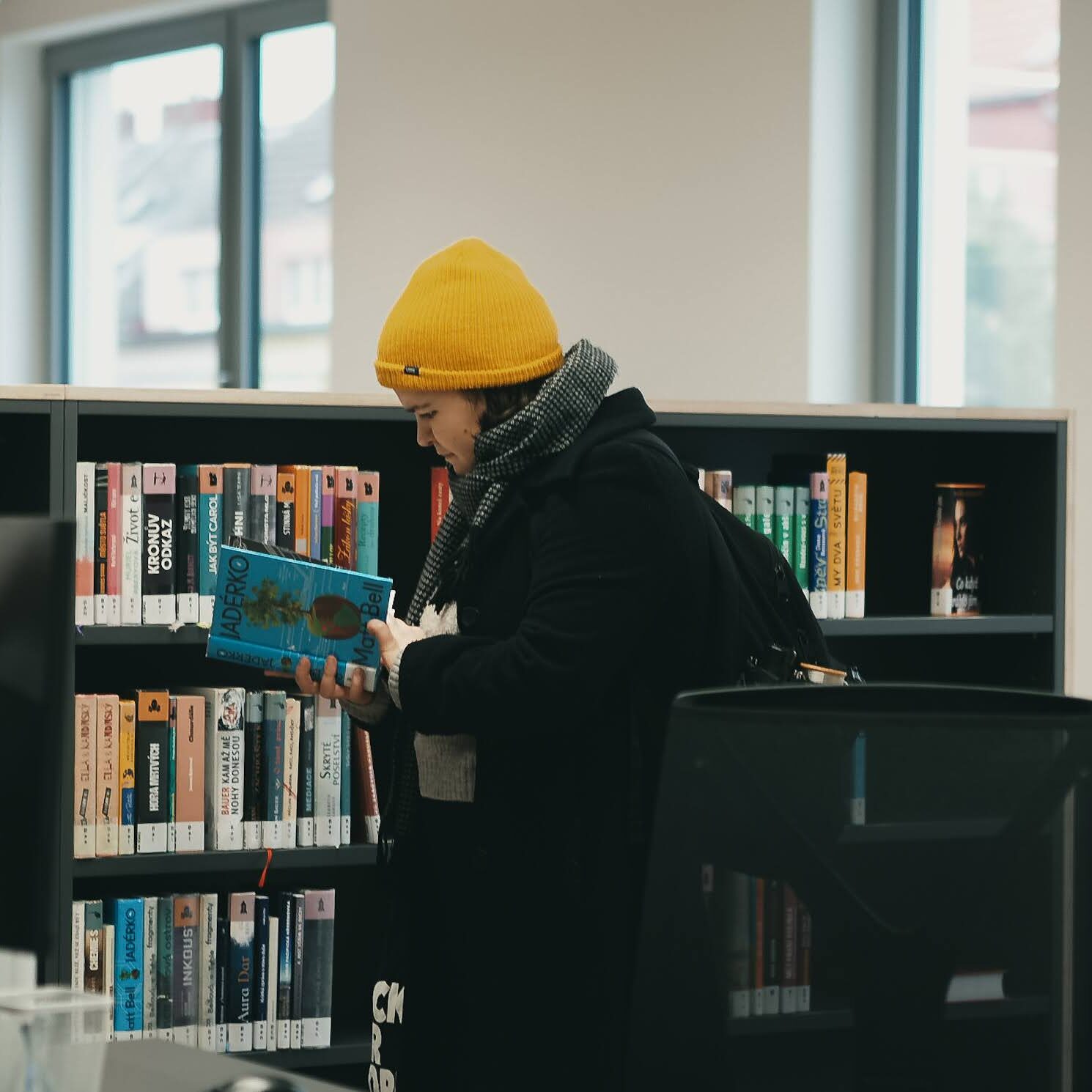
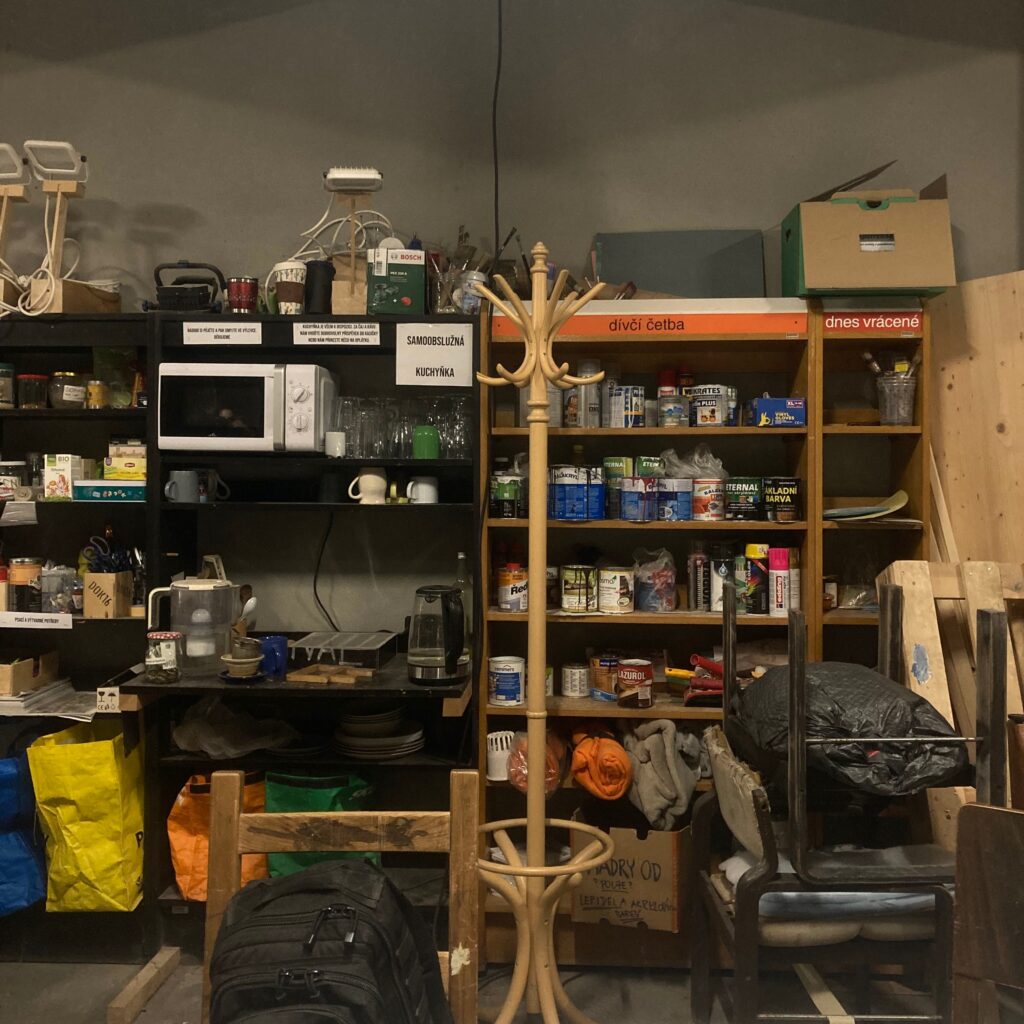
I perceive that the function and atmosphere of the branches reflect the space in which they are located. In the old and traditional building on Mariánské náměstí we find mainly the classical library, which everyone imagines first. On the other hand, the premises of the old mill in Palmovka give the library a more community atmosphere and this library is also more focused on various cultural events and meetings. The modern spaces in Petřiny are great for working with new technologies and the clean environment creates a great study space. DOK16 is, of course, quite unusual as a neighborhood woodshop.
Question 2: How do librarian roles differ depending on the type of library?
Each library focuses on slightly different services and it is important that librarians feel competent in their work. Librarians in the music department at the central library understand more about music, and they also lend technology to listen to music and work with different media. On the other hand, librarians working in the book shop and acquisitions need to understand the physical maintenance of books in particular. We also have a lot of teaching librarians who are involved in creating educational programs and facilitating them. Whatever the specifics of the librarian’s role, they all share a love of books, helpfulness and a desire to help.
Question 3: What technologies and systems does the library use to facilitate access to information and cataloguing of documents and other services?
Access to information, books and documents is provided by the internal MkP system, which connects all branches of the library. People can request to borrow books from different branches, they can return them anywhere and they know where to look for a book. One of the newest technologies used by the Municipal Library in Prague is an automatic book sorter, which helps to distribute returned books to different departments (in the case of the central library) or to different branches (in the case of the central sorter in Petřiny). The machine retrieves the books on return, evaluates where they belong and sends the book on the belt to the appropriate cart.
We thought for a while about whether to add the chips to the books one at a time or all at once. Of course, adding a new system to so many volumes in so many branches is challenging and it would be hard to do it all at once, but at the same time, converting piece by piece is problematic because of the interconnectedness of the library, which can cause us to forget some books. So we took it as a challenge and did it all at once in a few days.
Librarian of the central library
Question 4: Which library service interested or surprised you and why?
I was most surprised and excited by the library’s initiative to create a library of things. Specifically, they are starting this in the music department, where they want to lend out musical instruments like ukuleles and others, but they also just brought up sharing various tools or things that we only need a few times a year or even less. I think that in a big city like Prague, this is a great initiative, most people live in small apartments and thanks to such services they don’t have to overwhelm their space with things they don’t use often and instead borrow them.
Related to this is the great DOK16 project, a non-traditional library branch that acts as a neighborhood woodshop. It fosters community sharing and gives people access to new forms of self-development.
There are already articles observing the benefits of Libraries of Things and similar projects in the community, and I am excited to see how this service can shape the community around Prague library.
Certainly, tool and Thing libraries help create a more sustainable future for us all by providing a better way to share resources, promote reuse overconsumption, and contribute to the circular economy. But they also have the ability to empower communities, to give people the access and opportunity to learn how to do something new, to fix and repair their homes and belongings, and to improve themselves in ways they never thought possible at their local library
(Lax, 2020)
Question 5: In your opinion, should the library restrict access to computers and the internet for certain groups of people (e.g., young children) in its regulations?
From a pragmatic point of view, the library has to restrict access to computers because of limited capacity; if there are more people interested in using technology, it is the librarian’s job to make sure that everyone gets the space to use it. But the question itself leads me to education, which is primarily the responsibility of parents, and computer literacy is taught primarily in schools. I believe that restrictions are needed for some groups, especially for their personal safety. It is important to prevent access to illegal and dangerous sites. However, I think that further restrictions should not be about some outright bans but rather about guiding children (and adults) to use computers effectively and consciously. Introduce features that will help children’s development and education while also allowing them some “relaxing” and fun time on the internet. If necessary, I think a time limit is also appropriate, but with a clear explanation to the child. I myself use time limits on individual apps and believe it helps me to use apps consciously.
The library’s role in this case may be to take note of the parent’s wishes and create a safe online environment suitable for the child’s development.
Question 6: How do you perceive the spatial arrangement of the library?
I would like to expand on my answer to the first question by comparing how two completely different branches of the library, the one in Petřiny and the one in Palmovka, affected me.
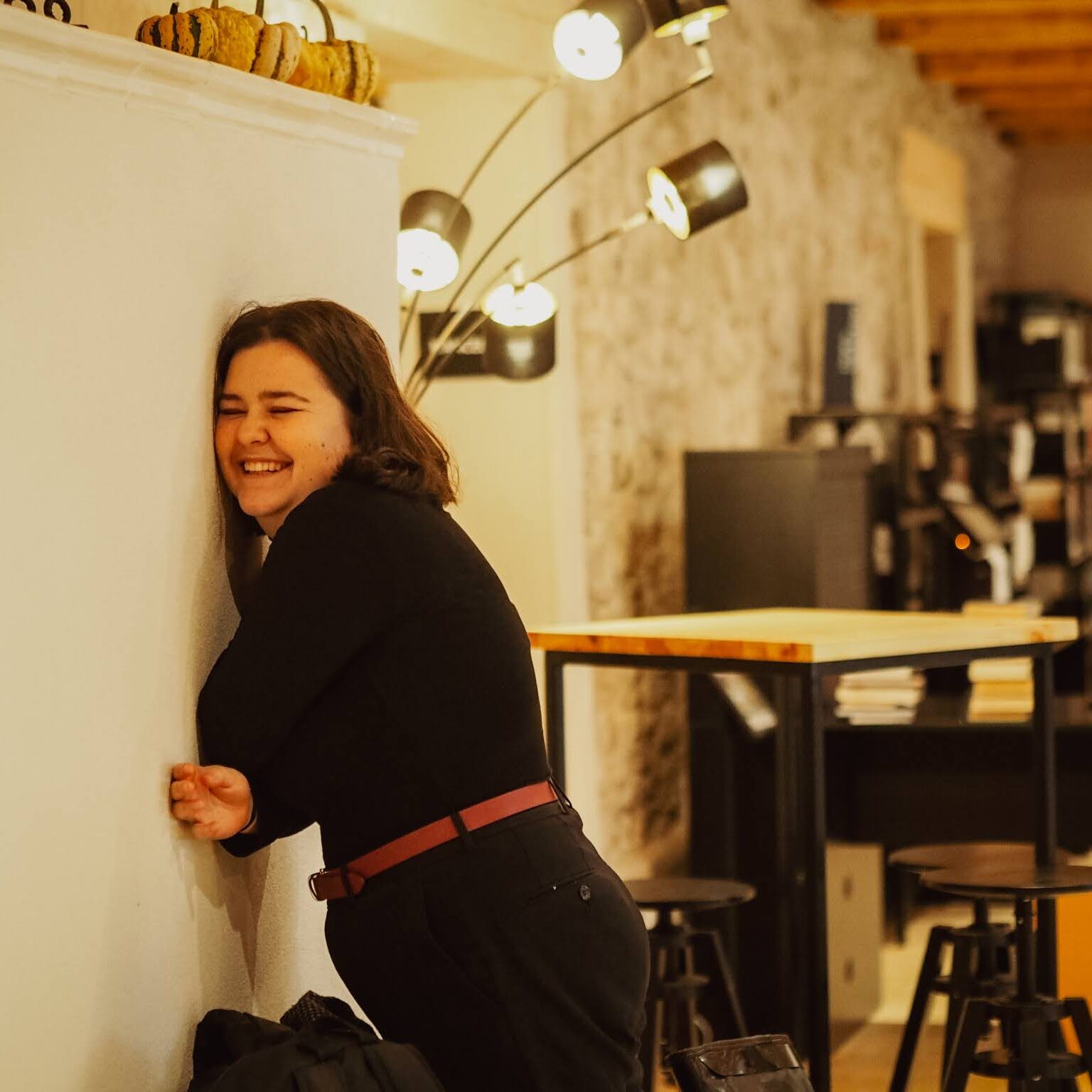
The big mill on Palmovka is like a big warm hug. We walk into the room with the fireplace, and in a minute, I feel that I have moved into a mountain hut, which is supposed to warm us up after a cold day outside. (I wasn’t far from the truth; the rainy November day on which the excursion took place definitely enhanced this feeling).
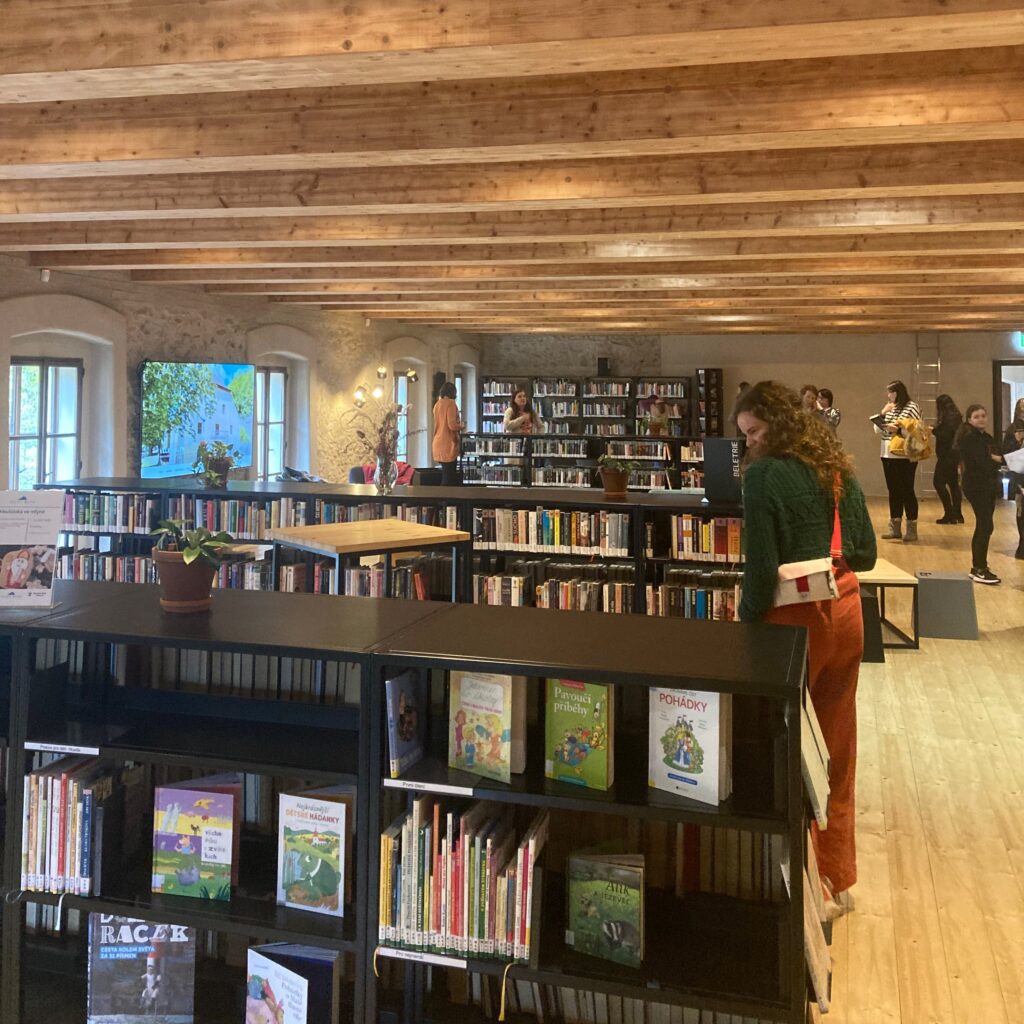
After the first look around, I knew I wanted to move in: the benches by the fireplace, the comfy sofas and chairs, the low shelves that I was sure I could reach and still look around the room.
After a conversation with the manager, we found out that this was exactly the intention, the bookcases are supposed to be just tall enough for anyone to lean against and look at a book right next to the shelf, the whole space was prototyped by making mock-ups of the different objects, putting them in the space and trying to work between them, ride the stroller, etc.
I think about the space very often and enjoy its friendliness and pleasant atmosphere. It must be perfect for winter evenings.
The Petřiny branch may seem sterile compared to the one on Palmovka. During our visit, it was only open for a few days, which is another aspect to take into account, but we can still notice many differences. Instead of dim, warm light, there is plenty of bright daylight thanks to the large windows and white lights on the ceilings. Still, I was comfortable in the library, seeing it more as a workspace where I would go to study or work than to sit with a book and read. Despite the fact that both branches are very new, this one seemed more unfinished, and above all, it was obvious that the librarians hadn’t quite gotten comfortable with the space.
This experience shows that there is no such thing as a proper library. Each space and each branch has different weaknesses and strengths, and each is suited to different target groups or events and activities.
Question 7: What do you think about the concept of a “virtual library”? How could such a library work, and what would be the advantages and disadvantages?
“The virtual library has been defined as the concept of remote access to the contents and services of libraries and other information resources, combining an onsite collection of current and heavily used materials in both print and electronic form, with an electronic network that provides access to, and delivery from, external worldwide library and commercial information and knowledge of sources. In essence the user is provided the effect of a library that is a synergy created by bringing together technologically the resources of many, many libraries and information services”
(Saunders, 1998)
I don’t see the concept of the virtual library as the one universal library including everything but as a form of online library or focus of libraries on online access to their publications. Online access to books and other publications is well established, mostly in the academic area. Most of the academic journals have their online database, and university libraries buy access to them. Thanks to that, we have access to them. The academic area is very specific, and we cannot ignore the debate around free access to knowledge and research, but it is a topic for a different article.
I am also really familiar with online libraries focused on audiobooks and ebooks, where I pay a certain amount of money for access to thousands of books and audiobooks. I see the advantage of cheaper access to English books and audiobooks, which is not that widespread in Czech libraries.
Thanks to virtual libraries, many more people living in remote areas can have access to literature. Another advantage is the forms of books; many people no longer listen to audiobooks through CD players but just through the libraries on their phones.
One great example is Illis Africa:
IlissAfrica was created in 2008 by the African Studies Library at the University of Frankfurt, Germany, in collaboration with other German libraries and research institutions. The project aimed to provide a central access point for information on Sub-Saharan Africa. The virtual library was designed to serve the needs of Africanists, students, and Africans living in Germany, as well as users from Sub-Saharan Africa. The project’s goal was to improve access to information about Sub-Saharan Africa and to promote research and scholarship in the field.
(Streit, 2011)
Question 8: What are the challenges and opportunities facing libraries in the digital age, and how are they trying to address these challenges?
To follow up on the previous question, I believe that the biggest challenge for libraries is moving into the online space. Both in the sense that creating a functional interface for a virtual library and processing everything in the best possible way is a challenging and costly task, but also because the digitization of libraries means that people will not go to them as much. Therefore, it is essential for libraries to create additional features and opportunities to be a relevant service to this society. We can see this in a greater focus on informal learning in libraries and a greater and greater role for the library as a community space. Libraries are now trying to focus more on cultural events, the artistic or technical development of participants, and the role of the library as a place to meet and work.
Sources
Lax, B. (2020). What Are These Things Doing in the Library? How a Library of Things Can Engage and Delight a Community. OLA Quarterly, 26(1), 54–61. https://doi.org/10.5399/osu/1093-7374.26.01.11
Saunders, L. M. (Ed.). (1998). The evolving virtual library: Visions and case studies (3. print). Information Today.
Streit, PhDr. V. (2011). IlissAfrica: Virtuální knihovna Subsaharské Afriky, její význam a přínos. Knihovna, 22(2), 101–106. http://knihovna.nkp.cz/knihovna112/112101.htm
Leave a Reply